
Many of us expect to go from full speed to fast asleep in a few minutes: answer the last email, scroll the news, switch off the light, and wonder why the mind is still racing. The body does not work like a light switch. It needs a ramp.
A wind-down routine is that ramp: a predictable sequence that tells your system the day is ending. It does not need to be long or elaborate. It needs to be gentle, and regular.
The hour before bed
Here is a simple structure. Adapt the timings to your life.
60 minutes before: close the day
- Finish work. Write tomorrow's top three tasks on paper so the mind can let go of them.
- Dim the lights in your home. Softer, warmer light signals evening.
- Light meal or nothing. If you eat late, keep it light.
45 minutes before: screens down
Put the phone on charge outside the bedroom or across the room. If you must use screens, dim them and avoid stimulating content. This is often the hardest step and the one that makes the biggest difference.
30 minutes before: move gently
This is where a few slow yoga poses help. Choose supported, quiet postures rather than anything strong or heating.
15 minutes before: breathe and pause
Slow breathing and a short moment of stillness.
Bedtime: lie down and let go
A brief body scan or yoga nidra in bed, then sleep.
Gentle movement: yin-style poses
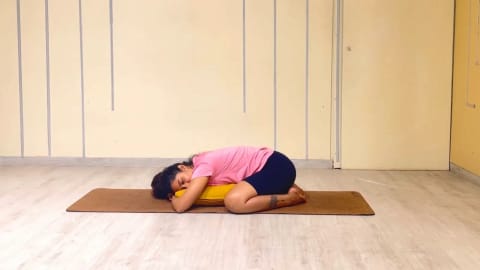
On Platonix, Day 7 of Tatwika's 7 Day Beginner Yoga series is titled Yin Yoga for relaxation, with a description of just three words, Reset & Rejuvenate. It uses a cushion for support in slow, quiet poses and finishes with alternate-nostril breathing, a natural model for an evening practice.
A short evening sequence in that spirit (about 12 minutes):
- Supported child's pose (2 minutes). Kneel, place a cushion lengthwise in front of you and fold forward over it, resting the chest and head. Let the breath slow.
- Seated side stretch (1 minute each side). Sit cross-legged, one hand on the floor, the other arm arching overhead.
- Supported reclining pose (3 minutes). Lie back over a cushion placed along the spine, arms open, knees bent or legs long.
- Supine twist (1 minute each side). Lying on your back, let both knees fall to one side.
- Legs up the wall (3 minutes). Lie with your hips near a wall and rest your legs up it.
Move slowly between poses. If any pose is uncomfortable, skip it or use more support.
Slow breathing
After the poses, sit up comfortably for a few minutes of slow breathing:
- Longer out-breath: breathe in for a count of four, out for six. Five to ten breaths.
- Alternate-nostril breathing: five to ten gentle rounds, without breath retention.
- Bhramari: three to five rounds of soft humming on the out-breath, if you enjoy sound.
Keep it soft. The goal is to settle, not to perform.
A moonlit pause
The Thasmai channel's Moon meditation on Platonix is barely a minute long and beautifully simple. Its on-screen instructions invite you to sit with your feet firmly planted on the ground, interlace your fingers and rest them on your lap, open your eyes and look at the moon, and if there is no moon, to look at the stars, and if there are no moon or stars, to look at the sky.
It is a lovely evening ritual: step onto a balcony or to a window, sit for a few minutes and simply look up. It connects the end of your day to something much larger than its worries.
In bed: let the body rest first
Once in bed, you might:
- Body scan: move attention slowly from the feet to the head, letting each area soften.
- Yoga nidra: follow a short recording such as Tatwika's 10 minutes Yoga Nidra.
- Gratitude: recall three small things from the day you appreciated.
If thoughts come, let them pass like traffic outside a window. There is nothing you need to do with them now.
Habits that support the routine
- Regular times. Going to bed and waking at similar times, including weekends, helps the routine work.
- Caffeine earlier. Many people sleep better if they avoid coffee and strong tea in the afternoon and evening.
- A cool, dark bedroom. Thick curtains and a slightly cool room help.
- Daylight in the morning. Getting outside early in the day supports the evening side of the rhythm.
Be patient
A new routine can take a couple of weeks to feel natural. Some nights will still be restless. That is normal. What matters is the general direction, not perfection.
If sleep problems persist, if you snore heavily, wake unrefreshed for long periods or feel very sleepy during the day, please consult a qualified health professional.
Start tonight
Watch Tatwika's Yin Yoga for relaxation | Anuloma Viloma Pranayama on Platonix this evening, then step outside for the Thasmai Moon meditation before bed.