
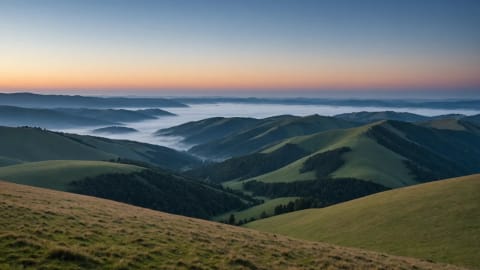
Ask practitioners from almost any Indian tradition when they meditate, and many will mention the same window: the quiet hours just before sunrise. This time is called Brahma Muhūrta, and it has a reputation for making stillness come more easily.
What is Brahma Muhurta?
A muhūrta is a traditional unit of time of about 48 minutes. Brahma Muhūrta, often translated as "the time of Brahman" or "the creator's hour", is commonly described as the period of two muhurtas, roughly 96 minutes, before sunrise. In many places that means somewhere between about 4 and 6 a.m., though the exact time shifts with the seasons and your latitude.
In Switzerland in winter, sunrise can be after 8 a.m.; in summer, before 6. In much of India the variation is smaller. If you want to observe Brahma Muhurta, look up your local sunrise and count back.
Why mornings have been prized
Traditional texts and teachers give several reasons, and most of them match ordinary experience:
- The world is quiet. Fewer sounds, fewer messages, fewer demands.
- The mind has not yet filled up. After sleep, the day's worries have not yet taken their seats.
- Habit and rhythm. Meditating at the same time each day builds momentum.
- A tone for the day. Many practitioners find that a few minutes of stillness at dawn colours the hours that follow.
On Platonix, the Vegetarian Meditation Channel offers a long recorded session titled Brahma Muhurtha Dhyanam, and the Thasmai channel's short Sun Meditation is another way to connect practice to the turning of the day.
But first: sleep
Here is the honest caveat. Brahma Muhurta works for people who go to bed early enough to wake rested. If waking at 4:30 means cutting sleep to five hours, the result is usually a groggy, nodding meditation and a tired day.
A sensible approach:
- Protect sleep first. Work backwards from your wake time to a realistic bedtime.
- Shift gradually. Wake 15 minutes earlier each week rather than jumping by two hours.
- Accept seasons. In winter in northern Europe, "before sunrise" may already be your normal wake time. Use it.
- Morning is still morning. If Brahma Muhurta is not practical, meditating soon after waking, before screens, captures much of the same quality.
A simple pre-dawn routine (30 minutes)
Wake and freshen (5 minutes)
Rise without the phone. Wash your face, rinse your mouth, drink a glass of water. Splashing cool water on the eyes helps if you feel heavy.
Loosen the body (5 minutes)
A few gentle stretches, neck rolls or a short sequence like the Tatwika channel's Easy Full Body Stretch wake the body without overexciting it.
Sit (15 minutes)
Choose one practice and keep it: breath awareness, a mantra, a short prayer followed by silence, or watching thoughts. Light a lamp if that helps you settle. Sit upright to stay alert.
Close (5 minutes)
Sit quietly for a moment after the technique. Some people read a verse from a text they are studying or write a line in a journal before beginning the day.
Staying alert at dawn
Early sittings bring their own challenge: drowsiness. Some tips:
- Sit upright rather than leaning back.
- Keep the room slightly cool.
- Open the eyes a little and rest the gaze on the floor ahead.
- Avoid heavy meals late at night.
- If you nod off, stand for a minute, then sit again.
What to practise in those early minutes
Tradition offers many options for this time, and it is best to choose one rather than trying to fit them all in:
- Silent sitting with the breath, simply knowing each in-breath and out-breath.
- Japa, the quiet repetition of a mantra, with or without a string of beads (mālā).
- Reflection on a verse. Read a single verse from a text such as the Bhagavad Gita, then sit with its meaning for a few minutes.
- Gentle breathing practice, for example a few rounds of alternate-nostril breathing without breath retention.
- Gratitude. Before the day's demands arrive, recall a few things you are grateful for.
Whatever you choose, keep it the same for a few weeks. Repetition is what lets the morning practice deepen.
A note for DACH and northern winters
If you live in Switzerland, Germany or Austria, winter mornings are dark well into the working day. That can actually make a pre-sunrise practice easier: you are already up in the dark. A small lamp or candle, a warm shawl and a cup of warm water afterwards can turn a cold, dark morning into something you look forward to. In summer, when sunrise comes very early, it is perfectly reasonable to practise "early morning" rather than strictly before dawn.
When mornings are not possible
Shift workers, new parents and people with health conditions may not be able to rise early, and that is fine. The tradition's deeper point is not the clock but the quality of attention: a regular time, a quiet mind and sincerity. An evening sitting before bed, or a pause at lunch, can carry the same intention.
If you have a sleep disorder or a health condition affected by your sleep schedule, talk to a qualified professional before changing your routine.
Begin tomorrow
Set a gentle alarm 15 minutes earlier than usual and simply sit. If you would like company, look for early-morning live sessions on Platonix, or try the Brahma Muhurtha Dhyanam recording from the Vegetarian Meditation Channel when you have time for a longer sitting.